


When you’re dealing with LPG lines, steam service, chemical flow, or any pressurised industrial pipeline, there’s one thing you never want to guess — what’s happening inside the line. You want to see it. Not after shutting down. Not after a leak. Not after a batch goes wrong. Right now, while the process is running.
That’s exactly where a Double Window sight glass becomes more than just a component — it becomes your safety check, your quality check, and your confidence check in one rugged, precision-engineered device.
At Mayur (Valves) System Private Limited, we supply industrial-grade Double Window LPG Sight Glass units in Class 150 and Class 300, with ready stock availability for urgent requirements. Whether you need it for visual monitoring of flow, colour, clarity, contamination, foaming, or movement, this sight glass supports reliable real-time observation without interrupting operations.
Why Double Window Sight Glass Matters in LPG and Critical Process Lines
If you’ve ever worked around LPG pipelines or volatile media lines, you already know the problem: the process is often hidden. And hidden processes create risk.
A sight glass is not just about visibility — it’s about decision-making.
With a Double-window flow sight glass, operators can monitor:
- Whether media is flowing properly
- Whether vapour pockets or blockages are forming
- Whether colour or clarity indicates contamination
- Whether there’s unexpected turbulence or flow behaviour
- Whether batch flow is stable during operation
In LPG systems, this becomes even more important because you’re not just managing product flow — you’re managing safety.
The double window design also gives an extra layer of protection. If one glass pane cracks, the second pane still provides a barrier and visual access. That’s a simple concept, but it’s one of those features you appreciate most when something goes wrong.
What Exactly Is a Double Window Sight Glass?
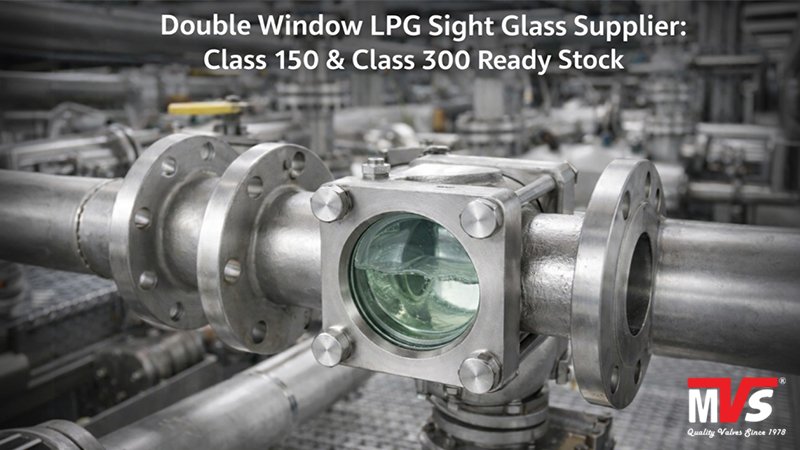
A Double Window Sight Glass is a viewing device built into a pipeline or process system to allow continuous monitoring of media inside the line. It typically consists of:
Two thick borosilicate glass panes mounted opposite each other inside a rugged body. This arrangement provides clear visibility and adds safety for pressurised service.
The sight glass body can be cast or fabricated, and for industrial applications, material quality is everything. That’s why many industries prefer configurations such as:
- Cast Carbon Steel Double Window Sight Glass
- duplex stainless-steel variants
- PTFE-lined Double Window Sight Glass for chemical resistance
At Mayur (Valves) System Private Limited, we focus on supplying these products for real industrial use — not decorative pipeline fittings, not light-duty pieces, but equipment that belongs in critical systems.
Class 150 & Class 300: Why Pressure Rating Is Not a Small Detail
If you’re sourcing a Double Window LPG Sight Glass, you’re usually not doing it for a low-pressure water line. You’re doing it because your process is pressurised, demanding, and sensitive.
That’s why pressure class matters.
- Class 150: Class 150 is widely used across standard industrial pipelines where pressure conditions are controlled and within moderate ranges.
- Class 300: Class 300 is preferred when the system pressure is higher, or when the process involves more risk, temperature variation, or aggressive media.
Both classes are used across LPG systems, chemical plants, steam pipelines, refineries, and process industries. But choosing the wrong class can lead to performance issues, safety concerns, or early failure. This is one reason buyers prefer working with an experienced supplier like Mayur (Valves) System Private Limited, because you don’t just get a product — you get clarity and confidence on what fits your system.
Built for Visibility: The Real Advantage of Double Window Design
Single window sight glasses exist, but in many industries they’re simply not enough.
A Double Window Sight Glass gives you:
- Better viewing clarity: Because light passes through the line, visibility is sharper. You can observe colour, clarity, and movement more accurately.
- Higher safety margin: Two glass panes mean an additional safety barrier.
- More suitable for harsh environments: This design is commonly selected for high pressure and elevated temperature conditions where safety and reliability are non-negotiable.
This is why Double Window Sight Glass units are so common in demanding process lines. And when LPG is involved, the value of this design becomes even more obvious.
Materials That Match Real Industrial Conditions
The sight glass body material is not something you choose casually. Different industries require different levels of strength, corrosion resistance, and compatibility.
At Mayur (Valves) System Private Limited, the most commonly requested material options include:
Cast Carbon Steel Double Window Sight Glass
This is a trusted choice for rugged industrial environments. It provides strength and durability, especially in systems where mechanical load, pressure, and temperature are consistent factors.
The demand for Cast Carbon Steel Double Window Sight Glass remains high because it’s practical, strong, and widely compatible with industrial pipeline systems.
Duplex stainless steel
When corrosion resistance becomes a major concern, duplex stainless steel is often preferred. It’s commonly selected for chemical, offshore, marine, and aggressive media environments.
The benefit of duplex stainless steel is that it offers a strong balance of mechanical strength and corrosion resistance.
PTFE-lined Double Window Sight Glass
For industries handling aggressive chemicals, pharmaceutical-grade processes, or sensitive media, the PTFE-lined Double Window Sight Glass is an excellent option.
PTFE lining helps reduce contamination risks and supports chemical resistance where standard metals may not perform well.
In fact, many plants that work with corrosive service specifically request PTFE-lined Double Window Sight Glass configurations for peace of mind and longer service life.
The Role of Borosilicate Glass in Industrial Sight Glass Units
Let’s be honest — the glass is the heart of the product.
Industrial double window sight glasses typically use thick borosilicate glass because it handles heat and pressure better than ordinary glass. It is widely used for industrial viewing applications due to its clarity and stability.
The real advantage is simple: you get dependable visibility without constant worry about fogging, distortion, or weak performance.
Where Double Window LPG Sight Glass Is Used Most Often
This product isn’t limited to LPG, but LPG is one of the strongest use-cases.
A Double Window Sight Glass is widely used in:
- LPG pipeline systems
- Steam service lines
- Chemical processing plants
- Pharmaceutical flow monitoring
- Oil & gas pipeline operations
- Refineries and storage terminals
- Water treatment and industrial utilities
In many of these environments, the same expectation exists: reliable visual monitoring without shutting down the process. This is why the Double-window flow sight glass is such a valuable tool. It supports continuous process checks and helps operators act early rather than reacting late.
Why PTFE-Sealed Gaskets Matter in Sensitive Applications
In chemical, pharmaceutical, and steam service, sealing quality can be the difference between safe operation and a long-term maintenance headache. Many Double Window Sight Glass units integrate PTFE-sealed gaskets because PTFE is well-known for chemical resistance and compatibility with a wide range of media.
This becomes especially valuable in:
- Chemical service
- Steam service
- Media where contamination must be avoided
- Systems where gasket degradation would cause downtime
When combined with a PTFE-lined Double Window Sight Glass, the performance becomes even more suitable for demanding applications.
Duplex Double Window Sight Glass: Why Buyers Ask for It
The keyword might look technical, but the buyer intent is very clear.
When someone asks for a Duplex Double Window Sight Glass, they usually need:
- Higher corrosion resistance
- Better durability in harsh service
- A stronger material option than standard stainless steel
A Duplex Double Window Sight Glass is often used where corrosion, pressure, and long-term reliability are all critical. And in industries where downtime is expensive, this is a smart choice.
The demand for Duplex Double Window Sight Glass models is growing, especially in process plants that want longer service life and fewer replacements.
What Makes a Double Window Sight Glass “Trusted” in Real Plants?
A sight glass is a simple idea, but in real industrial work, it’s not simple at all. The reliability depends on the design quality, material quality, gasket sealing, and how well it matches the pipeline conditions.
A properly built Double Window Sight Glass supports:
- Continuous monitoring
- Reduced process interruptions
- Early detection of abnormal flow
- Better safety awareness in the plant
- Faster troubleshooting for operators
And that’s why engineers and maintenance teams continue to choose Double Window Sight Glass units instead of relying only on instrumentation.
Instrumentation is essential, of course — but sight is still one of the most trusted confirmations in process monitoring.
Ready Stock for Class 150 & Class 300: Why This Matters for Buyers
Let’s talk about a real problem.
Many industrial plants don’t order a sight glass when everything is calm. They order it when:
- A shutdown is planned
- A new line is being commissioned
- A replacement is urgently required
- Inspection teams have flagged a missing flow indicator
- A leak or damage has occurred
In those moments, waiting weeks for supply is not an option.
At Mayur (Valves) System Private Limited, we focus on supplying Class 150 and Class 300 Double Window LPG Sight Glass units with ready stock availability, so buyers can act quickly and keep their operations moving.
This is one of the reasons procurement teams prefer working with a supplier who understands industrial urgency — and not just catalogue selling.
Valve Body Materials (Common Types & Where They’re Used)
ASTM A351 gr. CF8M 316 Stainless Steel: Type 316 is a corrosion resistant molybdenum alloy known for improved resistance to pitting in solutions containing chlorides and other halides. It also offers strong elevated temperature performance, tensile strength, creep strength, and resistance to stress and rupture, making it suitable for harsh industrial service.
ASTM A216 gr. WCB Carbon Steel: A widely used body material for standard service applications. It is commonly supplied with CR13SS/ stellite or 316SS trim, and the body is externally coated to protect against weather exposure in industrial environments.
ASTM A216 gr. LCB: This material is used for standard service where similar corrosion properties to WCB are required, but a lower temperature rating is needed. It is typically selected for applications requiring performance down to -46°C.
ASTM A351 gr. CF3M 316L Low Carbon Stainless Steel: Type 316L contains 0.03% carbon or less and is recommended when exposure in the carbide precipitation range cannot be avoided. It is especially useful where annealing after welding is not practical, making it a common choice for welded systems.
ASTM A351 gr. CF8 304 Stainless Steel: A general-purpose corrosion resistant alloy with low carbon content and non-magnetic properties. It is commonly used in many industrial environments, though it may be susceptible to chloride stress corrosion cracking in certain conditions.
ASTM A351 gr. CF3 304L Low Carbon Stainless Steel: Type 304L also has a carbon content of 0.03% or less and can be used in the as-welded condition without becoming susceptible to inter-granular corrosion. Like 304, it may still be vulnerable to chloride stress corrosion cracking and is commonly used where field working is required.
ASTM A351 gr. CN7M Alloy 20: Alloy 20 is known for superior resistance to stress corrosion cracking, especially in boiling 20 to 40% sulphuric acid. It also provides strong general corrosion resistance to sulphuric acid, excellent resistance to chloride stress corrosion cracking, and good mechanical strength and fabricability.
ASTM A296 gr. CW-12M Hastelloy C: Hastelloy C offers outstanding corrosion resistance in oxidising environments. It provides excellent resistance to pitting and stress corrosion cracking and maintains corrosion resistance in weld joints, making it suitable for high-endurance chemical service.
ASTM A296 gr. M-35 Monel: Monel is widely valued for superior corrosion resistance in many chemical applications and excellent resistance to salt water. It is often chosen for marine-related industrial environments and highly corrosive services.
Global Export Reach: Trusted Indian Manufacturing Across Key Markets
Valves manufactured in India, including wafer check valves, support a wide global market and are supplied across multiple regions with different pipeline standards and plant conditions. Indian-made wafer check valves are commonly supplied to Australia, the United States (USA), Canada, Mexico, Belgium, Germany, the European Union, the Netherlands, Spain, France, the UK, Denmark, Sweden, Finland, Poland, Austria, the Czech Republic, Romania, and Italy. In the Middle East, they are supplied to the United Arab Emirates, Qatar, Saudi Arabia, Oman, Bahrain, and Kuwait, while across Africa they serve Egypt, Nigeria, Kenya, South Africa, Morocco, Tunisia, Ethiopia, Uganda, Tanzania, and more. In Asia and nearby regions, they reach Indonesia, Vietnam, Malaysia, Thailand, the Philippines, Singapore, Kazakhstan, Sri Lanka, Japan, South Korea, and others, with additional supply to New Zealand, Costa Rica, Colombia, Argentina, Chile, Guyana, Brazil, Panama, Azerbaijan, Turkey, Israel, Ireland, Greece, Jordan, Lebanon, Trinidad and Tobago, the Kyrgyz Republic, and Uzbekistan. This wide export footprint highlights how Indian valve design and manufacturing is accepted across a broad range of industrial requirements, making it a dependable choice for international projects and long-term plant operation.
Why Choose us
Choosing the right supplier matters just as much as choosing the right product, because a Double Window LPG Sight Glass is not something you want to replace again and again. At Mayur (Valves) System Private Limited, we focus on supplying reliable, precision-engineered Double Window sight glass solutions that suit real industrial pipeline demands, especially for Class 150 and Class 300 requirements. Buyers choose Mayur (Valves) System Private Limited because we understand how urgent shutdown timelines can be, we maintain ready stock for common configurations, and we support customers with clear product guidance based on practical use. Whether you need Cast Carbon Steel Double Window Sight Glass, duplex stainless steel, or PTFE-lined Double Window Sight Glass, our approach stays focused on safety, compatibility, and long-term performance.
Conclusion
A Double Window LPG Sight Glass is one of those components that quietly protects your process every single day. It gives operators instant visibility into flow conditions, supports safer decision-making, and helps prevent surprises in critical pipeline systems. With Class 150 and Class 300 options, strong body materials, borosilicate glass visibility, and chemical-resistant configurations like PTFE-lined Double Window Sight Glass, it becomes a trusted part of industrial monitoring. At Mayur (Valves) System Private Limited, the focus stays on supplying the right product for real operating conditions, with ready stock availability and practical support. When your plant needs clear process visibility without disruption, this is one upgrade that truly pays back.
For Class 150 & Class 300 Double Window LPG Sight Glass ready stock and technical support, call +91 9998920298 or email mayurvalves@gmail.com for fast assistance and pricing.
Key Takeaways
- The Double Window Sight Glass allows real-time flow monitoring without interrupting the process.
- Class 150 and Class 300 selection should match your pressure and safety requirements.
- Cast Carbon Steel Double Window Sight Glass is ideal for rugged industrial service.
- duplex stainless steel and Duplex Double Window Sight Glass suit corrosive, harsh environments.
- PTFE-lined Double Window Sight Glass improves chemical resistance and reduces contamination risk.
FAQs
What is the purpose of a Double Window Sight Glass in LPG pipelines?
It allows operators to visually monitor flow behaviour, clarity, and movement of media in real time without interrupting the system.
What is the difference between Class 150 and Class 300 Double Window sight glass?
Class 150 suits moderate pressure systems, while Class 300 is selected for higher pressure or more demanding pipeline conditions.
When should I choose a PTFE-lined Double Window Sight Glass?
It is preferred when the process media is chemically aggressive or when non-contamination is important in sensitive industries.
Why is duplex stainless steel used in Double Window sight glass bodies?
duplex stainless steel is chosen for better corrosion resistance and durability in harsh service environments.
Can a Double-window flow sight glass be used for steam service?
Yes, it is commonly used for steam service where continuous visibility is needed under elevated temperature conditions.