
Strainer Manufacturer & Exporter
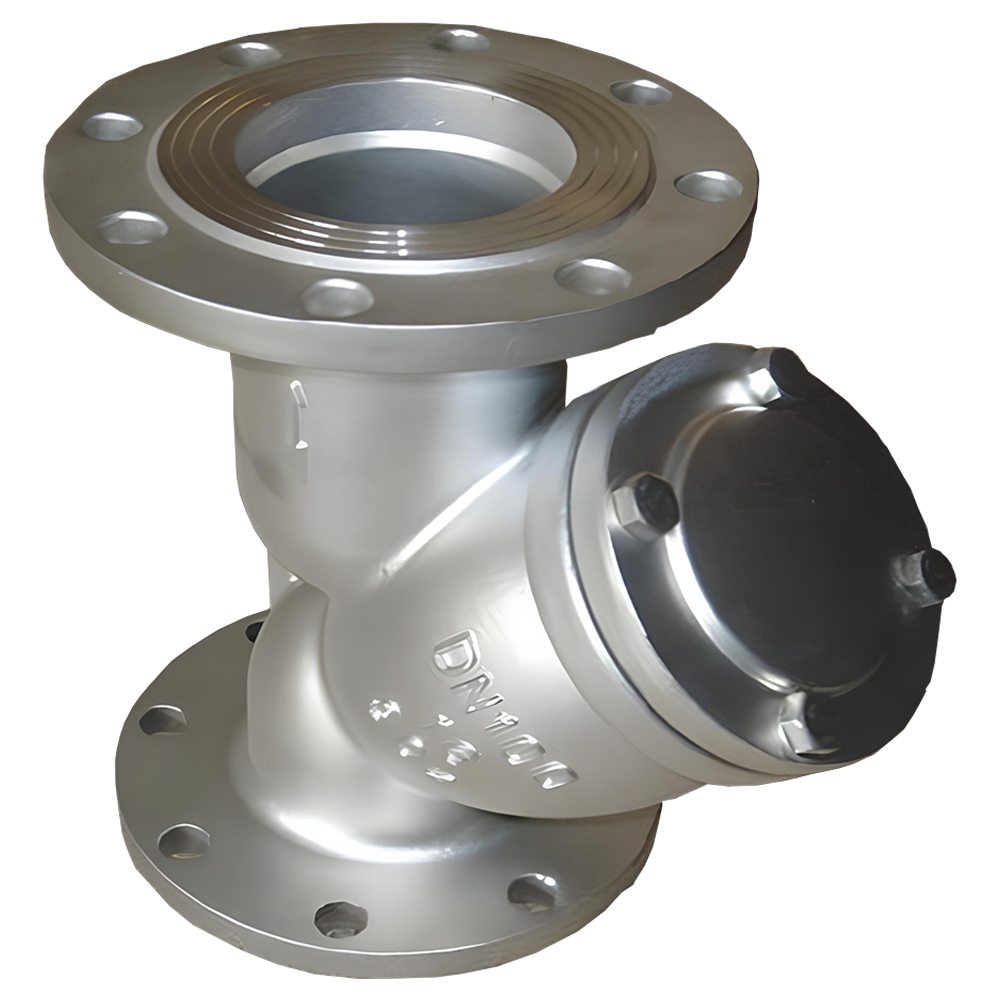
MVS Valves Y Strainer is engineered for effective debris removal and long-term protection of pipeline components in industrial fluid systems. Designed in a compact Y-shape, this strainer is ideal for coarse filtration, though it can also accommodate fine mesh when a larger filtration area is required. The internal screen captures solids from process media, which helps improve fluid clarity and extends the operational life of downstream equipment such as pumps, valves, meters, and regulators.Manufactured to perform reliably under various temperature and pressure conditions, the cast iron Y Strainer and cast steel Y Strainer options are widely used in water, air, gas, steam, and petroleum lines. For highly corrosive environments, stainless steel Y Strainer provides chemical resistance and robust construction that stands up to aggressive fluids. Where higher pressure ratings are necessary, the ANSI Class 600 Y Strainer variant delivers secure filtration without compromising flow rate or sealing integrity. In demanding chemical and marine applications, the Duplex Y Strainer offers excellent durability and strength against corrosion and stress.
MVS Y Strainers are available in flanged, threaded, and socket-weld end connections, tailored for installation ease and minimal maintenance. Each unit is tested to ensure leak-tight performance, long service life, and compliance with relevant global quality standards.
Strainer
Frequently Asked Questions
Can’t find your duty condition here? Send us the media, size, pressure and temperature and we will specify the valve. Contact us
What is a Y strainer?
A Y strainer is a pipeline filter whose screen sits in a branch angled off the main bore, giving the body its Y shape. Flow passes through the perforated or mesh screen, which traps scale, weld slag, rust and debris before they reach a pump, control valve, meter or nozzle downstream. The angled leg collects the debris and can be blown down or unbolted for cleaning.
Which strainers does MVS supply?
The Y Strainer in metal-bodied construction. For corrosive service, lined alternatives are available as the PTFE Lined Y Strainer and the PTFE Lined Basket Strainer Filter.
Y strainer or basket strainer — which do I need?
A Y strainer is compact, cheap and works in any orientation, but its screen area is limited, so it suits light and occasional dirt loading. A basket strainer sits vertically with a much larger screen area and a removable basket, so it holds far more debris and can be cleaned without breaking the line — the right choice for heavy or continuous dirt loading, and for large flows where a Y strainer would block quickly.
What sizes and pressure ratings are available?
The Y strainer is supplied from 1″ to 12″ (DN 25–DN 300) at ANSI 150# and ANSI 300#, with threaded, socket-weld or flanged ends. Larger sizes and higher classes are available on request — send us the line size, flow rate, flange standard and expected debris loading and we will confirm the build.
Which body and screen materials do you supply?
Bodies and covers in Carbon Steel (WCB), 304 and 316 stainless, bronze, CF8M, Hastelloy C-276 and duplex. Screens in stainless steel perforated sheet or wire mesh, with the mesh grade selected for the duty. Lined versions are available where the media would attack a metal body.
How do I choose the mesh or perforation size?
Work back from what you are protecting. Pumps and general service usually need coarse perforation; control valves, flow meters and nozzles need finer mesh matched to their smallest clearance. Finer is not automatically better — a mesh that is too fine blinds quickly, raises pressure drop and can collapse under differential. State what is downstream and the expected debris and we will recommend the grade.
How should a Y strainer be installed?
Fit it with the body arrow matching flow, and orient the screen leg so debris collects in it and can drain — pointing downward in a horizontal line, and to the side where headroom for removing the screen is limited. Leave clearance to withdraw the screen. On a vertical line, flow must be downward for the leg to collect rather than shed its debris back into the line.
How do I know when it needs cleaning?
Watch the differential pressure across it — a rising drop is the only reliable indicator, which is why permanent installations usually carry gauges either side. Cleaning is either a blowdown valve on the screen leg, or unbolting the cover and withdrawing the screen. A strainer left until it blocks does not just restrict flow; a collapsed screen sends the debris and the screen itself downstream.
Can strainers be supplied for corrosive service?
Yes. The PTFE lined Y strainer and lined basket strainer use the same lined construction as our lined valve range, with the screen in a compatible material, so acid and solvent lines get the same debris protection without exposing metal to the media.
Are you a manufacturer, and what is your minimum order quantity?
MVS is a manufacturer — building at its own works since 1978, ISO 9001:2015 certified — and exports across several continents. The minimum order quantity is 20 pieces. Special mesh grades, lined bodies and non-standard sizes are built to order.