


Key Takeaways
- Learn the benefits of PTFE lined ball valves for chemical plants in the UK.
- Discover key specifications to consider when you buy PTFE lined ball valve UK.
- Understand why lined construction is preferable to solid alloys for chemical services.
- Find out what information you need to provide for an accurate valve quotation.
- Explore the different lining materials available and their compatibility with various media.
Mayur (Valves) System Private Limited is a leading manufacturer and exporter of PTFE lined ball valves, fluoropolymer lined valves and PVDF valves, operating from Ahmedabad, India since 1978. If you run acid, solvent or chlor-alkali service in a British plant, you already know what happens when the wrong valve goes into the line. Seat attack, stem leakage, an unplanned isolation, and a maintenance team pulling a valve that should have lasted years.
The specification decisions that prevent that are made at the point of purchase. Here is what to look for.
Why Lined Construction Rather Than Solid Alloy
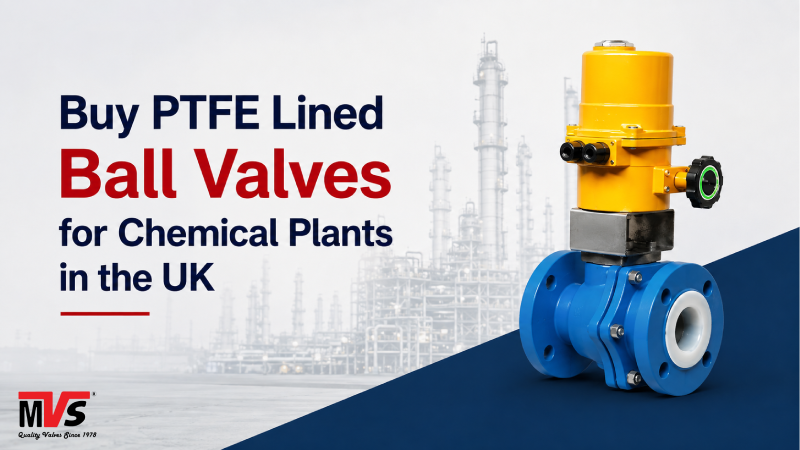
A lined ball valve combines a ductile iron or cast steel shell — which carries the pressure and the pipe loads — with a fluoropolymer barrier that the process media actually contacts. You get the mechanical strength of metal and the chemical inertness of PTFE, without the cost of an exotic alloy body.
For chemical, petrochemical, pharmaceutical, chlor-alkali and mineral acid service, this remains the practical answer. Solid alloy valves solve the same problem at considerably greater expense; unlined steel does not solve it at all.
Specifications That Matter When You Order
Our full port lined ball valve is manufactured to the following, and these are the figures worth checking against any quotation you receive:
- Size range: ½″ to 10″ (DN 15–250), including large-bore DN 200 (8″) and DN 250 (10″)
- Design standard: BS EN ISO 17292:2004 (formerly BS 5351)
- Face-to-face: ANSI B16.10 / BS EN 558-1/2
- Flange drilling: ASA #150, DIN 2632/2633, BS 10 Table D, E or F, or customer specified
- Lining thickness: 3 to 5 mm
- Testing standard: BS EN 12266-1 & 2 (2003)
- Hydraulic test: body (shell) 20 kg/cm², seat 11 kg/cm²
- Pneumatic test: seat 6 kg/cm²
- Spark test: 15 KVDC
That BS 10 Table D, E and F option deserves particular attention from UK buyers. Older British plants frequently retain Table D or E flanged pipework, and a valve supplied only with ANSI or DIN drilling means adaptor spools, extra joints and additional leak paths. Being able to buy PTFE lined ball valve UK installations need with the correct table drilling from the outset removes that problem entirely.
Construction and Operating Features
The valve uses a split body two-piece construction with a replaceable PTFE seat, giving bubble-tight shutoff and straightforward maintenance access. Several design details affect long-term performance:
- Maintenance-free glandless live load design — no gland packing to adjust, tighten or leak
- One-piece integral ball stem combination — eliminating a common failure point in conventional designs
- Minimum cavity with full flow efficiency — reducing entrapment of process media
- No backlash in stem and ball after prolonged service
- Exceptionally low torque compared with plug valve alternatives
Operation is by manual lever up to 100 mm and worm gear from 150 mm to 300 mm, with pneumatic actuators and gearboxes available as optional components for automated installations.
Choosing the Right Lining and Body Material
Media compatibility drives the lining choice, and this is where a proper conversation with a PTFE lined ball valve manufacturer saves money later:
- PTFE — the broad-spectrum choice for aggressive acids and general chemical service
- PFA (ASTM D 3307) — where higher purity and temperature capability are required
- FEP (ASTM D 2116) — excellent chemical resistance with good permeation performance
- PVDF (ASTM D 3222) — strong mechanical properties with wide chemical compatibility
- PP (ASTM D 4101) and HDPE — cost-effective for compatible, moderate-duty media
Body options cover Ductile Iron GGG 40.3 / ASTM A395, Cast Steel ASTM A216 Gr. WCB, and stainless steel in ASTM A351 Gr. CF8 (SS 304) or Gr. CF8M (SS 316) for applications where external corrosion or washdown conditions demand it.
What to Send Us for an Accurate Quotation
To quote properly rather than approximately, we need:
- Line size and quantity
- Process media, concentration and operating temperature
- Operating and design pressure
- Existing flange standard and table, where retrofitting
- Operation type — lever, gear, pneumatic or electric
- Any certification or documentation requirements for your project
Send a valve schedule, datasheet or P&ID extract and our engineering team responds with specification, materials and lead time.
We Supply Across the United Kingdom
Wherever your plant or project site sits, we deliver:
- Northwest England — Manchester and Liverpool, serving chemicals, oil and gas and manufacturing plants
- Yorkshire & Humber — Hull, Leeds and Sheffield, supplying water utilities, chemical works and steel producers
- Northeast England — Teesside and Middlesbrough, for petrochemical, LNG and fertiliser facilities
- West Midlands — Birmingham, supporting manufacturers and EPC contractors
- Scotland — Aberdeen, for offshore oil and gas operations
- South Wales — Swansea and Port Talbot, serving steel plants and refineries
- East Midlands — Derby and Nottingham, for food processing and power generation
- Southeast and East of England — pharmaceutical, water utility and food sector clients
- Northern Ireland — Belfast, covering manufacturing and water treatment
Why Choose Us
Mayur (Valves) System Private Limited has manufactured and exported since 1978 and remains one of India’s largest diaphragm and ball valve exporters, working under an ISO 9001:2015 certified quality system. We manufacture in-house rather than trading other people’s product, which means we accept genuine specification work — particular lining materials, specific body grades, non-standard flange tables and actuator mounting to your automation standard. Every valve is hydraulically, pneumatically and spark tested before dispatch, with documentation supplied. As an established lined ball valve supplier for chemical plants, we already export to the United Kingdom alongside more than sixty countries.
Conclusion
Buying lined valves well comes down to matching three things correctly: the lining to your media, the body material to your environment, and the flange drilling to your existing pipework. Get those right at the purchase stage and the valve does its job quietly for years. Get any one wrong and you are back in the line during the next shutdown. Our full port range covers ½″ to 10″ with PTFE, PFA, FEP, PVDF and PP linings, built to BS EN ISO 17292 and tested to BS EN 12266. MVS Valves supplies UK chemical processors factory-direct, without intermediaries.
Ready to specify or replace lined valves on your plant? Send your requirement and we will respond with a technical proposal covering materials, standards and delivery. Whether you need a single replacement or a full project schedule of fluoropolymer lined valves UK sites depend on, we can support it.
Call us at +91 9998920298 or email mayurvalves@gmail.com to request a quotation from Mayur (Valves) System Private Limited.
Frequently Asked Questions
What are PTFE lined ball valves used for in chemical plants?
PTFE lined ball valves are designed for applications involving aggressive chemicals, including acids and solvents. They provide a mechanical strength of metal combined with the chemical inertness of PTFE, making them ideal for chemical, petrochemical, and pharmaceutical industries.
How can I buy PTFE lined ball valves in the UK?
You can buy PTFE lined ball valves in the UK directly from manufacturers like Mayur (Valves) System Private Limited. By providing specifications such as line size, media type, and existing flange standards, you can receive an accurate quotation tailored to your needs.
What specifications should I check when purchasing PTFE lined ball valves?
Key specifications to check include the size range, design standards, face-to-face dimensions, flange drilling options, and lining thickness. Ensuring that these align with your requirements will help prevent installation issues and future maintenance problems.
What are the benefits of lined ball valves over solid alloy options?
Lined ball valves offer significant advantages, such as lower costs and greater chemical resistance due to their combination of a durable metal shell and a PTFE lining. This construction is particularly beneficial for chemical services where corrosive media is involved.
Can Mayur (Valves) System Private Limited supply PTFE lined ball valves across the UK?
Yes, Mayur (Valves) System Private Limited supplies PTFE lined ball valves throughout the UK, covering areas like Manchester, Liverpool, and Aberdeen. Their extensive distribution network ensures timely delivery to various industries, including chemical and pharmaceutical sectors.