
Key Takeaways
- PTFE seating delivers strong chemical resistance, making it ideal for aggressive media handling.
- Valve material selection (carbon steel, ductile iron, stainless steel) plays a crucial role in durability and application compatibility.
- Proper sealing and leak-tight performance improve operational safety in chemical industries.
- Compact butterfly valve design supports easy installation and reduced maintenance effort.
- Choosing a reliable API-standard manufacturer directly impacts long-term performance and efficiency.
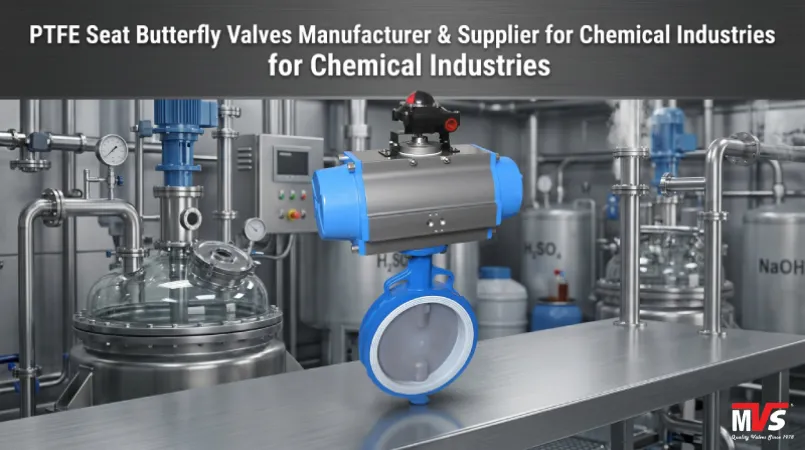
In the demanding environment of chemical processing industries, valve performance is not just about flow control—it directly impacts safety, efficiency, and operational continuity. When dealing with aggressive chemicals, corrosive media, and high-pressure systems, selecting the right valve becomes critical. This is where the PTFE Seated Butterfly Valve stands out as a dependable and efficient solution.
With advanced sealing technology and a design built for resilience, these valves have become a preferred choice across chemical plants, refineries, and process industries. MVS Valves has emerged as a trusted name in delivering high-quality butterfly valves that meet stringent industrial requirements. Manufactured with precision and engineered for long-term performance, these valves cater to applications where reliability cannot be compromised.
Understanding PTFE Seated Butterfly Valves
A PTFE-seated butterfly valve is designed with a PTFE (Polytetrafluoroethylene) lining or seat that offers exceptional resistance against chemical corrosion. Unlike traditional rubber or metal-seated valves, PTFE provides superior inertness, making it suitable for handling acids, alkalis, and various aggressive fluids.
The working mechanism remains simple—rotating a disc within the pipeline to regulate or isolate flow—but the presence of PTFE seating significantly enhances durability and sealing efficiency. This makes the valve not only reliable but also cost-effective in the long run.
A concentric PTFE-seated butterfly valve is especially popular in chemical industries due to its symmetrical design, where the shaft is centred within the disc. This design reduces friction and allows for smooth operation, even in demanding environments.
Importance in Chemical Industries
Chemical industries operate under conditions where even minor leakage or valve failure can lead to serious consequences. The PTFE Seated Butterfly Valve offers a robust solution by combining chemical resistance with tight sealing.
The non-reactive nature of PTFE prevents contamination, maintaining the purity of processed chemicals. Additionally, its ability to withstand a wide temperature range makes it suitable for various industrial processes. This adaptability is one of the key reasons why MVS Valves products are widely used across different sectors.
Material Variants for Diverse Applications
The performance of a valve largely depends on its construction material. Different industries require different material configurations based on operating conditions.
A carbon steel PTFE seated butterfly valve is often selected for applications requiring strength and resistance to mechanical stress. It performs well in high-pressure environments and offers durability for heavy-duty operations.
On the other hand, a ductile iron PTFE seated butterfly valve provides a balance between strength and flexibility. Its excellent impact resistance makes it suitable for pipelines that experience variable loads or vibrations.
For highly corrosive environments, a stainless-steel PTFE seated butterfly valve becomes the preferred choice. Its superior corrosion resistance, combined with PTFE lining, delivers exceptional performance in aggressive chemical conditions.
Design Advantages and Operational Efficiency
One of the biggest advantages of the PTFE Seated Butterfly Valve lies in its compact and lightweight design. Compared to other valve types, butterfly valves require less space and are easier to install. This becomes particularly beneficial in large-scale chemical plants where space optimisation plays a key role.
The quarter-turn operation allows for quick opening and closing, reducing operational time and effort. The smooth internal surface created by PTFE lining minimises friction, which helps maintain consistent flow and reduces energy consumption.
The concentric PTFE-seated butterfly valve design also contributes to even pressure distribution across the seat, improving sealing performance and extending valve life.
Compliance with Industry Standards
In industrial applications, adherence to international standards is essential. An API 609 PTFE seated butterfly valve manufacturer follows strict guidelines to deliver products that meet global performance benchmarks.
These standards focus on factors such as pressure ratings, material specifications, testing procedures, and dimensional accuracy. Choosing valves from a compliant manufacturer like MVS Valves adds an extra layer of reliability, as the products undergo rigorous quality checks before reaching the customer.
Applications Across Chemical Processes
The versatility of the PTFE-seated butterfly valve makes it suitable for a wide range of applications. From handling corrosive chemicals to managing fluid flow in complex piping systems, these valves perform consistently across various processes.
They are commonly used in acid handling systems, solvent transfer lines, water treatment plants, and pharmaceutical manufacturing units. The ability to maintain a tight seal while resisting chemical attack makes them indispensable in such environments.
A stainless-steel PTFE seated butterfly valve is often used in pharmaceutical and food-grade applications where hygiene and contamination control are critical. Meanwhile, a carbon steel PTFE seated butterfly valve finds its place in heavy industrial setups requiring robust performance.
Performance and Maintenance Benefits
Maintenance is a major concern in industrial operations, and the PTFE Seated Butterfly Valve addresses this effectively. The simple design reduces the number of components, which minimises wear and tear over time.
PTFE’s non-stick properties prevent material build-up inside the valve, making cleaning easier and less frequent. This not only reduces downtime but also lowers maintenance costs significantly.
The durability of materials used in MVS Valves products further enhances their lifespan, allowing industries to operate with confidence and minimal interruptions.
Role of MVS Valves in Industrial Excellence
When it comes to reliability and performance, MVS Valves has established itself as a leading provider of butterfly valves for chemical industries. Their commitment to quality, precision manufacturing, and customer-focused solutions makes them a preferred choice among industrial clients.
By offering a wide range of options, including ductile iron PTFE seated butterfly valve and stainless-steel PTFE seated butterfly valve, the company caters to diverse industrial requirements. Their expertise as an API 609 PTFE seated butterfly valve manufacturer reflects in the consistent performance of their products.
Major Valve Body Materials, Compositions & Applications
In chemical industries, the performance of a PTFE Seated Butterfly Valve depends not only on its sealing but also on the valve body material. The right material improves corrosion resistance, strength, and service life. At MVS Valves, material selection is aligned with real working conditions to match different chemical applications.
Valve Body Materials
ASTM A351 gr. CF8M 316 Stainless Steel
Offers strong resistance to pitting and chlorides, with excellent strength at high temperatures. Commonly used in a stainless-steel PTFE seated butterfly valve for aggressive media.
ASTM A216 gr. WCB Carbon Steel
A standard industrial material with protective coating. Suitable for general applications in a carbon steel PTFE seated butterfly valve.
ASTM A216 gr. LCB
Used for low-temperature services (down to -46°C) with similar corrosion properties as WCB.
ASTM A351 gr. CF3M 316L Stainless Steel
Low carbon content makes it ideal for welded systems without post-weld treatment. Suitable for a PTFE-seated butterfly valve in process industries.
ASTM A351 gr. CF8 304 Stainless Steel
General-purpose corrosion-resistant alloy, widely used but less effective in chloride-heavy environments.
ASTM A351 gr. CF3 304L Stainless Steel
Low carbon variant used in welded applications, reducing the risk of intergranular corrosion.
ASTM A351 gr. CN7M Alloy 20
Highly resistant to sulfuric acid and chloride stress corrosion. Used in demanding chemical processes and concentric PTFE-seated butterfly valve designs.
ASTM A296 gr. CW-12M Hastelloy C
Performs well in oxidising environments with strong resistance to pitting and corrosion.
ASTM A296 gr. M-35 Monel
Provides excellent corrosion resistance, especially in saltwater and chemical applications.
Available Valve Body Material Categories
MVS Valves offers multiple options for PTFE Seated Butterfly Valve solutions, including:
Carbon Steel, Low Temperature Carbon Steel, Low Alloys, Stainless Steel grades, Duplex & Super Duplex, Bronze, Nickel Alloys, and Titanium.
Global Reach & Industry Acceptance
The reliability of a PTFE Seated Butterfly Valve is reflected in its wide global usage across diverse industries and operating conditions. Solutions from MVS Valves are supplied to major markets including Australia, United States, Canada, Germany, France, and the United Kingdom, along with several countries across Europe.
In the Middle East, these valves are widely used in United Arab Emirates, Saudi Arabia, Qatar, and Oman, while in Africa, they are supplied to South Africa, Egypt, Nigeria, and Kenya.
Across Asia-Pacific regions, demand continues to grow in India, Indonesia, Malaysia, Japan, and South Korea. The valves are also supplied to countries in South America such as Brazil and Argentina.
This wide presence highlights how a PTFE-seated butterfly valve adapts easily to different standards, process requirements, and plant conditions, making it a dependable choice across global industries.
Why Choose Us
Choosing MVS Valves means partnering with a company that understands the complexities of chemical industry operations. With years of experience and a strong focus on engineering excellence, MVS Valves delivers products that combine durability, precision, and performance. Each PTFE Seated Butterfly Valve is designed to handle challenging environments while maintaining consistent efficiency. The company focuses on quality materials, strict testing standards, and customer satisfaction, which makes their valves a dependable choice. Whether it is a concentric PTFE-seated butterfly valve or a specialised material variant, the solutions are tailored to meet real industrial needs without compromise.
Conclusion
The growing demand for reliable and efficient flow control solutions in chemical industries has made the PTFE Seated Butterfly Valve an essential component. Its ability to resist corrosion, maintain tight sealing, and perform consistently under challenging conditions makes it a valuable investment. From carbon steel PTFE seated butterfly valve to stainless steel PTFE seated butterfly valve, each variant serves a specific purpose, offering flexibility across applications. With trusted manufacturers like MVS Valves, industries gain access to high-quality solutions that support long-term operations. Choosing the right valve not only improves efficiency but also strengthens safety and reliability across the entire system.
Looking for high-performance PTFE Seat Butterfly Valves for chemical industries? Contact MVS Valves today at +91 9998920298 or email mayurvalves@gmail.com for expert guidance and product details.
FAQs
What is a PTFE Seated Butterfly Valve used for?
It is used for controlling flow in pipelines handling corrosive chemicals, acids, and aggressive fluids.
Why is PTFE preferred for valve seating?
PTFE offers excellent chemical resistance, low friction, and long-lasting sealing performance.
What is the benefit of a concentric PTFE-seated butterfly valve?
It provides smooth operation, uniform sealing, and reduced wear due to its centred design.
Which material is best for chemical applications?
A stainless steel PTFE seated butterfly valve is ideal for highly corrosive environments, while ductile iron and carbon steel are used for other conditions.
Why choose an API 609 PTFE seated butterfly valve manufacturer?
It guarantees compliance with international standards, providing reliable performance and safety in industrial operations.