

Key Takeaways
- High-performance valves designed for LPG and propane handling demand precision, durability, and reliable sealing.
- Single Piece Ball Valve and Two-Piece Ball Valves offer distinct advantages based on maintenance and application needs.
- Full port design improves flow efficiency in Full Port Flanged End Connections in CL 150 and CL 300 ratings.
- Material options like carbon steel, stainless steel, and duplex steel enhance performance across environments.
- Automation-ready valves like pneumatic models increase operational control and safety.
In industries dealing with LPG and propane, reliability is not just expected—it becomes critical. From storage terminals to transportation pipelines, every component must perform with absolute consistency. Among these components, floating ball valves play a central role in controlling flow while maintaining safety standards.
At Mayur (Valves) System Private Limited, we understand these operational challenges closely. Our engineering approach focuses on delivering robust valve solutions that meet the rigorous demands of LPG and propane applications. Whether it is a Single Piece Ball Valve or advanced 2 pc split body floating ball valves, each product is designed with performance, longevity, and safety in mind.
Understanding Floating Ball Valves in LPG & Propane Systems
Floating ball valves operate using a ball that is not fixed but held in place by seats. When pressure is applied, the ball moves slightly to create a tight seal. This design is particularly effective for gas applications where leak prevention is essential.
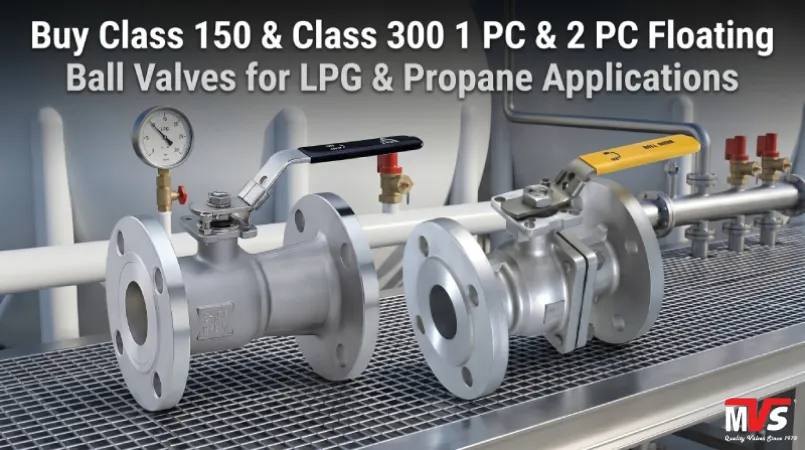
Both 1PC Ball Valve class 150 and class 300 and 2PC Floating Ball Valve configurations are widely used in LPG handling due to their ability to provide tight shut-off under varying pressures. The Full Port Flanged End Connections in CL 150 and CL 300 ratings further enhance performance by allowing unrestricted flow, reducing pressure drop.
Single Piece Ball Valves: Compact Strength
The 1 Piece Ball Valve is designed as a compact, robust solution. It features a single body construction, which reduces the number of leak paths and enhances structural integrity.
In LPG and propane systems, Carbon Steel One Piece Ball Valve Full Port Flanged CL 150 – CL 300 variants are often used for their strength and resistance to pressure. Similarly, Stainless-Steel One-Piece Ball Valve Full Port Flanged CL 150 – CL 300 offers corrosion resistance, making it suitable for environments exposed to moisture or chemicals.
For more demanding environments, Duplex SS One Piece Ball Valve Full Port Flanged CL150 – CL 300 provides enhanced strength and resistance to stress corrosion cracking.
Automation is also possible with Pneumatic One-Piece Ball Valve Full Port Flanged CL 150 – CL 300, allowing remote operation in hazardous areas.
Additionally, the 1 pc ball valve flanged ends class 150 and class 300 configuration is widely preferred for its ease of installation and reliability.
Two Piece Ball Valves: Flexibility and Maintenance
While single piece valves offer compactness, 2 Piece Ball Valves provide flexibility and easier maintenance. The body is split into two parts, allowing internal components to be accessed without removing the entire valve from the pipeline.
The 2-pc split body floating ball valves are particularly useful in industries where maintenance downtime must be minimised. With this design, inspection and repairs become more convenient.
Material options such as Carbon Steel Two Piece Ball Valve Full Port Flanged CL 150 – CL 300, Stainless-Steel Two-Piece Ball Valve Full Port Flanged CL 150 – CL 300, and Duplex SS Two Piece Ball Valve Full Port Flanged CL 150 – CL 300 allow industries to select valves based on operating conditions.
For automated systems, Pneumatic Two-Piece Ball Valve Full Port Flanged CL 150 – CL 300 enhances efficiency, while SS ISO Mount Pad Fire Safe Two-Piece Ball Valve Full Port Flanged CL 150 – CL 300 adds an extra layer of safety in fire-prone environments.
Performance Advantages in LPG & Propane Applications
Floating ball valves are widely used in LPG and propane systems because of their ability to handle volatile gases safely. The sealing mechanism in Single Piece Ball Valve and Two-Piece Floating Ball Valve configurations reduces leakage risks significantly.
The Full Port Flanged End Connections in CL 150 and CL 300 ratings allow smooth flow, which is essential in gas transfer operations. Reduced turbulence also contributes to longer service life.
The MVS Valve range is engineered to perform consistently even under fluctuating pressure conditions. This makes them suitable for both upstream and downstream applications.
Material Selection and Its Impact
Material plays a major role in valve performance. For LPG and propane systems, durability and resistance to environmental factors are key.
- Carbon Steel One Piece Ball Valve Full Port Flanged CL 150 – CL 300 offers strength and affordability.
- Stainless-Steel One-Piece Ball Valve Full Port Flanged CL 150 – CL 300 provides corrosion resistance.
- Duplex SS One Piece Ball Valve Full Port Flanged CL150 – CL 300 adds superior mechanical properties.
Similarly, in two-piece designs:
- Carbon Steel Two Piece Ball Valve Full Port Flanged CL 150 – CL 300 handles high-pressure applications.
- Stainless-Steel Two-Piece Ball Valve Full Port Flanged CL 150 – CL 300 suits chemical exposure.
- Duplex SS Two Piece Ball Valve Full Port Flanged CL 150 – CL 300 supports harsh industrial conditions.
These material choices make both One Piece Ball Valve class 150 and class 300 and 2 pc split body floating ball valves adaptable across industries.
Automation and Safety Features
Modern LPG systems often require automation. Pneumatic actuators are widely used to control valves remotely. The Pneumatic One-Piece Ball Valve Full Port Flanged CL 150 – CL 300 and Pneumatic Two-Piece Ball Valve Full Port Flanged CL 150 – CL 300 are designed to meet this requirement.
Fire safety is another critical factor. The SS ISO Mount Pad Fire Safe Two-Piece Ball Valve Full Port Flanged CL 150 – CL 300 provides protection in extreme conditions, preventing catastrophic failures.
At Mayur (Valves) System Private Limited, we integrate such features into our MVS Valve product line to meet global safety standards.
Applications Across Industries
Floating ball valves are used across a wide range of LPG and propane applications:
- Storage terminals
- Gas distribution pipelines
- Industrial processing units
- Refineries and petrochemical plants
The 1 pc ball valve flanged ends class 150 and class 300 is ideal for compact installations, while Two Piece Floating Ball Valve designs are preferred in systems requiring frequent maintenance.
Major Valve Body Materials, Compositions & Applications
When selecting valves for LPG and propane applications, the choice of body material quietly shapes everything—from corrosion resistance to long-term performance under pressure. It’s not just about strength; it’s about how the material reacts over time in real operating conditions. At Mayur (Valves) System Private Limited, we often guide clients through this decision because the right material can significantly improve both safety and lifecycle value of a valve.
Valve Body Materials
Below are some of the most commonly used valve body materials, along with their compositions and real-world applications:
ASTM A351 gr. CF8M 316 Stainless Steel
This corrosion-resistant alloy, widely known as Type 316, contains molybdenum, which improves resistance to pitting in environments with chlorides and halides. It also performs well under elevated temperatures, offering strong tensile strength, creep resistance, and durability in high-pressure systems. It is commonly used in chemical processing and LPG handling environments where corrosion resistance matters.
ASTM A216 gr. WCB Carbon Steel
A widely used material for standard service applications, WCB carbon steel offers reliable mechanical strength. It is typically supplied with trims such as CR13 stainless steel, Stellite, or 316 stainless steel. The external coating helps protect against weather exposure, making it suitable for outdoor LPG and propane installations.
ASTM A216 gr. LCB
Similar to WCB in corrosion characteristics, LCB is designed for lower temperature applications, functioning effectively down to -46°C. This makes it suitable for cold environments where LPG storage and handling systems operate under reduced temperatures.
ASTM A351 gr. CF3M 316L Low Carbon Stainless Steel
With a carbon content of 0.03% or less, 316L is particularly useful in welded systems where post-weld heat treatment is not practical. It reduces the risk of carbide precipitation, maintaining corrosion resistance in welded joints—an important factor in complex piping systems.
ASTM A351 gr. CF8 304 Stainless Steel
A general-purpose corrosion-resistant alloy with low carbon content, CF8 is non-magnetic and suitable for a wide range of applications. However, it may be vulnerable to chloride stress corrosion cracking, which should be considered in certain LPG environments.
ASTM A351 gr. CF3 304L Low Carbon Stainless Steel
This material, with its reduced carbon content, performs well in as-welded conditions without becoming prone to intergranular corrosion. It is often used in field-fabricated systems where welding is common, though it may still face challenges in chloride-heavy conditions.
ASTM A351 gr. CN7M Alloy 20
Known for its excellent resistance to sulfuric acid and chloride stress corrosion cracking, Alloy 20 performs well in aggressive chemical environments. It combines strong mechanical properties with good fabrication characteristics, making it suitable for specialised industrial applications.
ASTM A296 gr. CW-12M Hastelloy C
Hastelloy C offers outstanding resistance in oxidising environments and performs exceptionally well against pitting and stress corrosion cracking. It also maintains corrosion resistance across welded joints, which adds to its reliability in critical applications.
ASTM A296 gr. M-35 Monel
Monel is recognised for its superior resistance to corrosion in chemical and marine environments. Its excellent performance in saltwater makes it a strong choice for coastal or offshore LPG installations.
Available Valve Body Material Categories
At Mayur (Valves) System Private Limited, our supply capabilities cover a broad spectrum of materials to meet diverse industrial needs:
- Carbon Steel
- Low Temperature Carbon Steel
- Low Alloys
- 13% Cr Stainless Steel
- Austenitic Stainless Steel
- Precipitation Hardening Stainless Steel
- Duplex & Super Duplex Stainless Steel
- Bronze
- Nickel Alloys (825, 625, 718)
- Titanium
Global Reach & Industry Acceptance
What truly reflects the strength of a valve design is not just how it performs in one plant, but how consistently it works across different countries, standards, and operating environments. At Mayur (Valves) System Private Limited, our solutions are not limited to a single region—they are part of a wide global network of industries that rely on dependable valve performance every day.
Our valves serve a broad international market, reaching countries such as Australia, the United States, USA, Canada, Mexico, Belgium, Germany, the European Union, the Netherlands, Spain, France, the UK, Denmark, Sweden, Finland, Poland, Austria, the Czech Republic, Romania, and Italy. Across the Middle East, our products are supplied to the United Arab Emirates, Qatar, Saudi Arabia, Oman, Bahrain, and Kuwait, where demanding operating conditions require both strength and reliability.
In Africa, industries in Egypt, Nigeria, Kenya, South Africa, Morocco, Tunisia, Ethiopia, Uganda, and Tanzania rely on our valve solutions for consistent performance. Across Asia and nearby regions, our presence extends to Indonesia, Vietnam, Malaysia, Thailand, the Philippines, Singapore, Kazakhstan, Sri Lanka, Japan, and South Korea, supporting a wide range of industrial applications.
Beyond these, our valves also reach New Zealand, Costa Rica, Colombia, Argentina, Chile, Guyana, Brazil, Panama, Azerbaijan, Turkey, Israel, Ireland, Greece, Jordan, Lebanon, Trinidad and Tobago, the Kyrgyz Republic, and Uzbekistan.
This wide adoption across continents reflects one simple truth—the design, material selection, and engineering behind every MVS Valve product work effectively across varying standards, climates, and plant conditions. It shows that whether the requirement is for LPG systems, petrochemical plants, or general industrial use, the performance remains consistent and dependable.
Why Choose Us
At Mayur (Valves) System Private Limited, we don’t just manufacture valves—we build solutions that industries rely on every day. Our approach focuses on combining engineering expertise with practical application needs. We understand the challenges faced in LPG and propane systems, which is why our MVS Valve range is designed with durability, precision, and safety at its core. From Two Piece Ball Valves to Single Piece Ball Valve configurations, every product reflects our commitment to quality and performance. We work closely with our clients, offering not just products but dependable support, helping them choose the right valve for their specific requirements. That’s what makes our solutions trusted across industries.
Conclusion
Choosing the right valve for LPG and propane applications is not something that can be overlooked. It directly affects safety, efficiency, and long-term operational stability. With options like Two Piece Floating Ball Valve, 2 pc split body floating ball valves, and Single Piece Ball Valve, industries have the flexibility to select solutions that match their exact needs. At Mayur (Valves) System Private Limited, we bring together advanced design, quality materials, and real-world understanding to deliver valves that perform consistently under demanding conditions. Whether it’s Class 150 or Class 300 ratings, our focus remains on delivering reliability where it matters most.
Looking for reliable Class 150 & Class 300 floating ball valves for LPG & propane systems? Contact us at +91 9998920298 or email mayurvalves@gmail.com for expert guidance and product details.
FAQs
What is the difference between a one-piece and two-piece ball valve?
A Single Piece Ball Valve has a compact, solid body, while Two Piece Ball Valves offer easier maintenance with a split body design.
Why are full port valves preferred in LPG applications?
Full port valves reduce pressure drop and allow smooth flow, which is essential in gas systems.
Which material is best for LPG valves?
It depends on the application. Stainless steel and duplex stainless steel provide better corrosion resistance compared to carbon steel.
What are Class 150 and Class 300 valves?
These are pressure ratings that define how much pressure a valve can handle safely in operation.
Can these valves be automated?
Yes, options like Pneumatic Two-Piece Ball Valve Full Port Flanged CL 150 – CL 300 and pneumatic one-piece valves support automation systems.